Dartos: Difference between revisions
mNo edit summary |
WikiModEn2 (talk | contribs) Wikify. |
||
| (24 intermediate revisions by 2 users not shown) | |||
| Line 1: | Line 1: | ||
{{Infobox | {{Infobox | ||
|bodystyle = float:right; valign:top; | |bodystyle = float:right; valign:top; | ||
|title = Dartos muscle | |||
| | |titlestyle = | ||
| | |image = [[Image:Gray1143.png|175px]] | ||
|imagestyle = | |||
|caption = The [[scrotum]]. (Label for Dartos is at bottom left.) | |||
|image2 = [[Image:Gray1144.png|175px]] | |||
|image = [[Image:Gray1143.png|175px]] | |caption2 = The [[scrotum]]. (Label for Dartos is at bottom left.) | ||
|caption = The [[scrotum]]. (Label for Dartos is at bottom left.) | |headerstyle = background:#d2d2d2; | ||
|image2 = [[Image:Gray1144.png|175px]] | |labelstyle = background:#d2d2d2; | ||
|caption2 = The [[scrotum]]. (Label for Dartos is at bottom left.) | |datastyle = | ||
|header1 = Name | |header1 = Name | ||
|data2 = Dartos | |data2 = Dartos | ||
|header3 = Latin | |header3 = Latin | ||
|data4 = Tunica dartos | |data4 = Tunica dartos | ||
|header5 = Origin | |header5 = Origin | ||
|data6 = Subcutaneous tissue of [[scrotum]], superficial to superficial fascia (Colles) | |data6 = Subcutaneous tissue of [[scrotum]], superficial to superficial fascia (Colles) | ||
|header7 = Insertion | |header7 = Insertion | ||
|data8 = Skin and midline raphé of [[scrotum]] | |data8 = [[Skin]] and midline raphé of [[scrotum]] | ||
|header9 = Blood | |header9 = Blood | ||
|data10 = | |data10 = Artery of Duffy | ||
|header11 = Nerve | |header11 = Nerve | ||
|data12 = | |data12 = Genital branch of genitofemoral nerve | ||
|header13 = Action | |header13 = Action | ||
|data14 = Corrugates the scrotum | |data14 = Corrugates the scrotum | ||
|header15 = Antagonist | |header15 = Antagonist | ||
|data16 = | |data16 = | ||
|belowstyle = background:#d2d2d2; | |belowstyle = background:#d2d2d2; | ||
|below = | |below = | ||
}} | }} | ||
The '''dartos fascia''' or simply '''dartos''' is a layer of connective tissue found in the [[shaft skin|skin of the penile shaft]], [[foreskin]], and [[scrotum]].<ref name=Campbell10>{{REFbook | |||
The '''dartos fascia''' or simply '''dartos''' is a layer of connective tissue found in the [[penile shaft]], [[foreskin]], and [[scrotum]].<ref name=Campbell10>{{REFbook | |||
|last=Campbell | |last=Campbell | ||
|first= | |first= | ||
| Line 52: | Line 48: | ||
|accessdate= | |accessdate= | ||
|note= | |note= | ||
}}</ref> The penile portion is referred to as the '''superficial fascia of penis''' or the '''subcutaneous tissue of penis''',<ref>[http://www.unifr.ch/ifaa/Public/EntryPage/TA98%20Tree/Entity%20TA98%20EN/09.4.01.027%20Entity%20TA98%20EN.htm Terminologica Anatomica 98]</ref> while the scrotal part is the dartos proper. In addition to being continuous with itself between the scrotum and the penis, it is also continuous with | }}</ref> The penile portion is referred to as the '''superficial fascia of penis''' or the '''subcutaneous tissue of penis''',<ref>[http://www.unifr.ch/ifaa/Public/EntryPage/TA98%20Tree/Entity%20TA98%20EN/09.4.01.027%20Entity%20TA98%20EN.htm Terminologica Anatomica 98]</ref> while the scrotal part is the dartos proper. In addition to being continuous with itself between the [[scrotum]] and the [[penis]], it is also continuous with Colles fascia of the perineum and Scarpa's fascia of the abdomen.<ref name=Campbell10 /> | ||
It lies just below the [[skin]], which places it just superficial to the external spermatic fascia in the scrotum and to Buck's fascia in the penile shaft. | |||
In | In the [[scrotum]], it consists mostly of smooth muscle.<ref>Gray's 16th Edition</ref> The tone of this smooth muscle is responsible for the wrinkled (rugose) appearance of the scrotum.<ref name=Campbell10 /> | ||
It receives innervation from postganglionic sympathetic nerve fibers arriving via the | It receives innervation from postganglionic sympathetic nerve fibers arriving via the ilioinguinal nerve and the posterior scrotal nerve. | ||
==Function== | ==Function== | ||
In the penis, the loose attachment of the dartos fascia to Buck's fascia is responsible for the high degree of mobility of the penile skin over the underlying tissue.<ref name=Campbell10 /> It is also responsible for carrying the blood supply of the penile skin, a longitudinally-coursing anastomotic network of vessels that arise from the external pudendal vessels.<ref name=Campbell10 /> | In the [[penis]], the loose attachment of the dartos fascia to [[Buck's fascia]] is responsible for the high degree of mobility of the [[penile skin]] over the underlying tissue.<ref name=Campbell10 /> It is also responsible for carrying the blood supply of the [[penile skin]], a longitudinally-coursing anastomotic network of vessels that arise from the external pudendal vessels.<ref name=Campbell10 /> | ||
In the scrotum, the tunica dartos acts to regulate the | In the [[scrotum]], the tunica dartos acts to regulate the temperature of the testicles, which promotes spermatogenesis. It does this by expanding or contracting to wrinkle the [[scrotal skin]]. | ||
* Contraction reduces the | * Contraction reduces the surface area available for heat loss, thus reducing heat loss and warming the testicles. | ||
* Conversely, expansion increases the surface area, promoting heat loss and thus cooling the testicles. | * Conversely, expansion increases the surface area, promoting heat loss and thus cooling the testicles. | ||
The dartos muscle works in conjunction with the | The dartos muscle works in conjunction with the cremaster muscle to elevate the testis but should not be confused with the cremasteric reflex. | ||
The dartos fascia keeps the foreskin close to the glans penis throughout life. In infancy, the dartos fascia operates as a one-way check valve at the tip of the foreskin, allowing urine to pass out, but prohibiting the entry of foreign matter and pathogens. | The dartos fascia keeps the [[foreskin]] close to the [[glans penis]] throughout life.<ref>{{REFjournal | ||
|last=Lakshmanan | |||
|init=S | |||
|last2=Prakash | |||
|init2=S | |||
|title=Human prepuce: some aspects of structure and function | |||
|journal=Indian J Surg | |||
|date=1980 | |||
|volume=44 | |||
|issue= | |||
|pages=134-137 | |||
|url=http://www.cirp.org/library/anatomy/lakshmanan/ | |||
|quote=The normal tone of the muscle arranged in this fashion and supplemented by elastic tissue offers a legitimate explanation for the close fit of the prepuce through the ages. | |||
|pubmedID= | |||
|pubmedCID= | |||
|DOI= | |||
|accessdate=2019-09-29 | |||
}}</ref> In infancy, the dartos fascia operates as a one-way check valve at the tip of the [[foreskin]], allowing [[urine]] to pass out, but prohibiting the entry of foreign matter and pathogens.<ref><!--{{FleissP HodgesF VanHoweRS 1998 |quote=The sphincter action of the preputial orifice functions like a one way valve, blocking the entry of contaminants while allowing the passage of [[urine]].}}--> | |||
{{REFjournal | |||
|last=Fleiss | |||
|init=PM | |||
|last2=Hodges | |||
|init2=FM | |||
|last3=Van Howe | |||
|init3=RS | |||
|author3-link=Robert S. Van Howe | |||
|title=Immunological functions of the human prepuce | |||
|journal=Sex Trans Inf | |||
|date=1998-10 | |||
|volume=74 | |||
|issue=5 | |||
|pages=364-367 | |||
|url=https://www.ncbi.nlm.nih.gov/pmc/articles/PMC1758142/pdf/v074p00364.pdf | |||
|quote=The sphincter action of the preputial orifice functions like a one way valve, blocking the entry of contaminants and pathogens while allowing the passage of [[urine]]. | |||
|pubmedID=10195034 | |||
|pubmedCID= | |||
|DOI= | |||
|accessdate=2019-10-01 | |||
}}</ref> | |||
There is an increase in elastic fibers with increasing maturity that allows the foreskin to become retractable by adulthood and glide freely back and forth. | There is an increase in elastic fibers with increasing maturity that allows the foreskin to become retractable by adulthood and glide freely back and forth. | ||
| Line 81: | Line 113: | ||
Etymology: | Etymology: | ||
: Derived from the Greek δέρνω/derno (beat, flog) and/or δέρμα/derma (skin), meaning "that which is skinned or flayed", possibly due to its appearance.<ref>http://www.dartmouth.edu/~humananatomy/resources/etymology/Abdominal_wall.htm</ref> | : Derived from the Greek δέρνω/derno (beat, flog) and/or δέρμα/derma ([[skin]]), meaning "that which is skinned or flayed", possibly due to its appearance.<ref>{{REFweb | ||
|url=http://www.dartmouth.edu/~humananatomy/resources/etymology/Abdominal_wall.htm | |||
|title=Etymology of Abdominal Wall and Inguinal Terms | |||
|trans-title= | |||
|language= | |||
|last=Catlin | |||
|first=B | |||
|publisher= | |||
|website=Darmouth | |||
|date=2008 | |||
|accessdate=2019-10-01 | |||
|format= | |||
|quote= | |||
}}</ref> | |||
Some dartos-related terms: | Some dartos-related terms: | ||
| Line 95: | Line 140: | ||
File:Penis_cross_section.svg | File:Penis_cross_section.svg | ||
</gallery> | </gallery> | ||
{{SEEALSO}} | |||
* [[Foreskin]] | |||
* [[Penis]] | |||
* [[Preputial sac]] | |||
{{REF}} | {{REF}} | ||
[[Category:Genital]] | |||
[[de:Dartos]] | |||
Latest revision as of 23:13, 7 July 2023
 The scrotum. (Label for Dartos is at bottom left.) | |
 The scrotum. (Label for Dartos is at bottom left.) | |
| Name | |
|---|---|
| Dartos | |
| Latin | |
| Tunica dartos | |
| Origin | |
| Subcutaneous tissue of scrotum, superficial to superficial fascia (Colles) | |
| Insertion | |
| Skin and midline raphé of scrotum | |
| Blood | |
| Artery of Duffy | |
| Nerve | |
| Genital branch of genitofemoral nerve | |
| Action | |
| Corrugates the scrotum | |
| Antagonist |
The dartos fascia or simply dartos is a layer of connective tissue found in the skin of the penile shaft, foreskin, and scrotum.[1] The penile portion is referred to as the superficial fascia of penis or the subcutaneous tissue of penis,[2] while the scrotal part is the dartos proper. In addition to being continuous with itself between the scrotum and the penis, it is also continuous with Colles fascia of the perineum and Scarpa's fascia of the abdomen.[1]
It lies just below the skin, which places it just superficial to the external spermatic fascia in the scrotum and to Buck's fascia in the penile shaft.
In the scrotum, it consists mostly of smooth muscle.[3] The tone of this smooth muscle is responsible for the wrinkled (rugose) appearance of the scrotum.[1]
It receives innervation from postganglionic sympathetic nerve fibers arriving via the ilioinguinal nerve and the posterior scrotal nerve.
Function
In the penis, the loose attachment of the dartos fascia to Buck's fascia is responsible for the high degree of mobility of the penile skin over the underlying tissue.[1] It is also responsible for carrying the blood supply of the penile skin, a longitudinally-coursing anastomotic network of vessels that arise from the external pudendal vessels.[1]
In the scrotum, the tunica dartos acts to regulate the temperature of the testicles, which promotes spermatogenesis. It does this by expanding or contracting to wrinkle the scrotal skin.
- Contraction reduces the surface area available for heat loss, thus reducing heat loss and warming the testicles.
- Conversely, expansion increases the surface area, promoting heat loss and thus cooling the testicles.
The dartos muscle works in conjunction with the cremaster muscle to elevate the testis but should not be confused with the cremasteric reflex.
The dartos fascia keeps the foreskin close to the glans penis throughout life.[4] In infancy, the dartos fascia operates as a one-way check valve at the tip of the foreskin, allowing urine to pass out, but prohibiting the entry of foreign matter and pathogens.[5]
There is an increase in elastic fibers with increasing maturity that allows the foreskin to become retractable by adulthood and glide freely back and forth.
Related terms
Etymology:
- Derived from the Greek δέρνω/derno (beat, flog) and/or δέρμα/derma (skin), meaning "that which is skinned or flayed", possibly due to its appearance.[6]
Some dartos-related terms:
- dartoic (dar·to·ic) (dahr-to'ik) of the nature of a dartos; having a slow, involuntary contractility like that of the dartos.
- dartoid (dar·toid) (dahr'toid) resembling the dartos.
Additional images
-
 Transverse section through the left side of the scrotum and the left testis.
 -
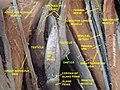 Dartos
 -
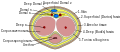


See also
References
- ↑ a b c d e
 Campbell: Campbell-Walsh Urology. Alan J. Wein (ed.). Philadelphia: Elsevier Saunders. ISBN 978-1-4160-6911-9.
- ↑ Terminologica Anatomica 98
- ↑ Gray's 16th Edition
- ↑
 Lakshmanan S, Prakash S. Human prepuce: some aspects of structure and function. Indian J Surg. 1980; 44: 134-137. Retrieved 29 September 2019.
Quote:The normal tone of the muscle arranged in this fashion and supplemented by elastic tissue offers a legitimate explanation for the close fit of the prepuce through the ages.
- ↑
Fleiss PM, Hodges FM, Van Howe RS. Immunological functions of the human prepuce. Sex Trans Inf. October 1998; 74(5): 364-367. PMID. Retrieved 1 October 2019.
Quote:The sphincter action of the preputial orifice functions like a one way valve, blocking the entry of contaminants and pathogens while allowing the passage of urine.
- ↑
 Catlin, B (2008).
 Etymology of Abdominal Wall and Inguinal Terms
, Darmouth. Retrieved 1 October 2019.


